Catholic Relief Services and the US Department of Agriculture announced an agreement on Tuesday to deliver nearly a quarter-billion dollars in emergency aid to Sudan and Ethiopia, two countries hard-hit by a hunger crisis affecting at 70 million people across the East Africa region.
Crux Now heard from senior officials at both CRS and USDA ahead of the public announcement of the agreement, which involves grants totaling $235 million for 110,000 metric tons of staple foodstuffs.
RELATED: CRS partners with USDA to feed hungry in Sudan, Ethiopia
RELATED: Crux Now Q&A: Senior USDA official praises CRS as $235 million aid partnership is launched
That’s an enormous quantity in absolute terms – it could feed more than six million people for a month or a half-million people for a year – but the scope of the hunger crisis in East Africa is almost unimaginably daunting.
“The scale of need can be difficult to comprehend,” CRS president and CEO Sean L. Callahan told Crux Now. “More than 33 million people in Sudan need humanitarian assistance,” he said, “and an estimated 825,000 children face severe acute malnutrition.”
“This agreement helps ensure families in Ethiopia and Sudan have access to the food they need during a time of extraordinary hardship,” Callahan told Crux Now.
In this regard, he praised local CRS partners, who are “absolutely top-notch individuals” and organizations – including local Churches – superlatively doing extraordinarily challenging work in some of the world’s most difficult places.
Callahan, who had copious praise for CRS local partners on Tuesday, made that specific remark in a follow-up conversation on Wednesday, after the public announcement.
Sudan has been at war with itself almost constantly for more than 70 years and is currently in the fourth year of gruesome civil strife that has caused massive displacement and exacerbated other natural and economic crises.
RELATED: Sudan’s Forgotten War: A Church leader cries out for peace
Ethiopian agriculture has been disrupted by its own conflicts, as well, and other natural conditions have combined with severe recurrent drought to bring already high unemployment, endemic poverty, and rising food prices to crisis levels.
Ethiopia also hosts more than a million refugees from neighboring and nearby countries including Sudan, South Sudan, Somalia, and Eritrea.
RELATED: Drought driving new crisis of child hunger in Ethiopia, Catholic experts say
U.S. assistance has played a critical life-saving role in the fight against global hunger and poverty for the better part of a century.
In early 2025, however, the Trump administration decided effectively to shutter the agency chiefly responsible for aid distribution – the US Agency for International Development, USAID – leading to major aid shortfalls.
Aid and development organizations were sharply critical of the cuts, which also gravely affected CRS, once a top recipient of USAID support.
“The changes to U.S. foreign assistance affected CRS’ footprint and programming levels,” Callahan told Crux Now on Tuesday.
“[W]e made the difficult decision to close some programs and offices,” he said, but “CRS remains committed to serving vulnerable communities around the world.”
Late last year, with the support of U.S. lawmakers from both parties, an agreement among agencies and departments of the federal executive branch brought a major assistance project – the Food for Peace program – to the USDA.
Callahan told Crux Now CRS is looking forward to working with USDA.
“We are grateful for USDA’s continued commitment through Food for Peace,” Callahan said, “which reflects enduring bipartisan support for addressing global hunger.”
Below, please find the full exchange between Crux Now and CRS President and CEO Sean L. Callahan …
Crux Now: Who reached out to whom?
Sean L. Callahan: CRS has been a proud partner of USDA for decades and we continually talk to them about the best way to partner with them and use food aid as a tool to save lives and help communities move forward on a pathway to prosperity.
Assistance to these two countries has come up naturally within this ongoing conversation.
How long has this agreement been in the works?
CRS welcomed the chance to engage in earnest regarding opportunities for continued partnership in the Food for Peace Program once it was publicly announced at the start of the year that USDA would be administering the program through an interagency agreement.
We welcomed the chance to dive into specifics when it was appropriate and are so grateful the agreement has come together and hope that the conversation continues to move forward as quickly as possible.
How great is the need in East Africa, and how far does the agreement advance the CRS mission?
Today, millions of people across East Africa are struggling to feed their families.
The scale of need can be difficult to comprehend: More than 33 million people in Sudan need humanitarian assistance and an estimated 825,000 children face severe acute malnutrition.
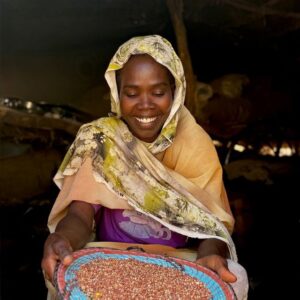
For the most vulnerable families, the absence of a safety net means they face hunger while struggling to recover and rebuild their lives.
This agreement is lifesaving, enabling CRS to provide vital food assistance that helps families meet their immediate nutritional needs and weather these incredibly difficult circumstances with dignity.
We are grateful to build on our decades-long partnership with USDA through Food for Peace, connecting the generosity and productivity of American farmers with families around the world who need that support most.
In Ethiopia and especially in Sudan, security and accountability are major concerns for donor nations and aid / dev agencies on the ground: How does CRS ensure both?
CRS has worked in both Ethiopia and Sudan for many years through trusted local partners, faith communities and other humanitarian organizations.
Those longstanding relationships allow us to adapt to changing conditions while maintaining strong oversight and accountability.
CRS tracks food commodities through the supply chain to the last mile and employs robust monitoring, verification and financial oversight to help ensure assistance reaches the people it is intended to serve.
Like all Food for Peace programs, this work is subject to rigorous monitoring, financial controls and reporting requirements.
We continually assess security conditions, adjust operations as needed and work closely with local partners to help ensure assistance reaches the people it is intended to serve.
Was CRS affected by the effective shuttering of USAID in 2025?
The changes to U.S. foreign assistance affected CRS’ footprint and programming levels, and we made the difficult decision to close some programs and offices.
Despite those challenges, CRS remains committed to serving vulnerable communities around the world. Today, CRS supports communities in 95 countries and last year reached more than 200 million people.
We are grateful for USDA’s continued commitment through Food for Peace, which reflects enduring bipartisan support for addressing global hunger.
This agreement helps ensure families in Ethiopia and Sudan have access to the food they need during a time of extraordinary hardship.
CRS does both emergency aid and long-term development work. How much of each does or may the USDA package support?
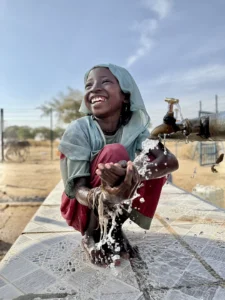
While this agreement is focused on emergency food assistance, CRS also implements long-term development and resiliency programs in both Ethiopia and Sudan.
Together, these complementary efforts help communities move from crisis toward recovery whenever conditions allow.
USDA saw CRS as a partner in this project: Why?
CRS has partnered with USDA through Food for Peace for decades, bringing together the productivity of American farmers with trusted humanitarian delivery systems around the world.
Our longstanding presence in both Ethiopia and Sudan, combined with strong local partnerships and rigorous accountability systems, allows us to deliver assistance efficiently and responsibly.
We have extensive experience managing large-scale food assistance programs and maintaining careful stewardship of U.S. government resources.
That combination of technical expertise, operational capacity and deep community relationships enables CRS to deliver assistance effectively, even in complex humanitarian settings.
Follow Chris Altieri on X: @craltieri