The death toll topped 1,300 with 5,600 persons missing Friday, nine days after a disintegrating glacier at the headwaters of a Himalayan river system triggered catastrophic flash flooding along the Nepal-China border.
Emergency responders at a hydro-electric facility on the Chinese side of the border rescued two plant workers Friday, a rare and welcome bit of good news amid appalling destruction and dwindling hope.
Among the many daunting challenges people in the affected regions are facing, the task of identifying remains is a logistical challenge and a spiritual trial.
The apostolic administrator for Nepal – a nation of 31 million, only 10 thousand of whom are Catholic – Fr. Silas K. Bogati told Crux Now some of the bodies were already decomposing when they were discovered, and could not be kept in refrigerators.
RELATED: Nepal’s senior Church leader describes harrowing situation in wake of disaster
“They have therefore been placed in specially dug graves in the soil as a preservation technique,” Bogati said. “DNA samples have been collected,” he said, “and the bodies have been properly marked and documented.”
This arrangement, however, is not permanent.
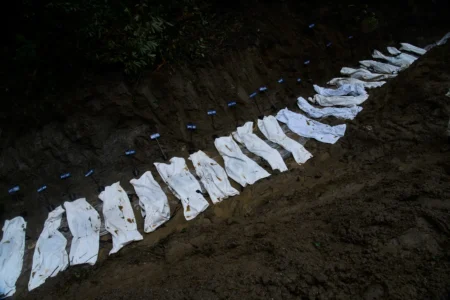
“This not a burial in the traditional sense,” Bogati said.
“It is a preservation measure,” he said, “in line with international standards so that, if someone later comes looking for a missing relative, the remains can be identified through DNA and handed over to the family.”
“In Nepalese culture,” Bogati told Crux Now, “you cannot hold a burial service unless you have a corpse.”
“There are no symbolic burials,” he said.
Bogati said he is still trying to ascertain the fate of Catholics in the flood-affected areas.
We know for sure that around 25 to 30 Catholics may have been washed away,” he said, “however, their bodies have not yet been found.”
“Until the bodies are recovered,” he said, “we cannot officially confirm them as deaths.”
The area around the epicenter of the incident, near the Nepal-China border, was particularly badly hit.
There are hiking and trekking paths in the affected region, which are popular with tourists. The area devastated by the flooding also contains a major Hindu pilgrimage route as well. I
“Many Indians and international tourists were there, and some of our Catholics were also working there as daily-wage laborers,” Bogati told Crux Now.
“We are still trying to find out what has happened to them. That part of the country has been completely cut off because the river went right through the area,” he also said.
For years, experts have been warning of climate-change-driven glacial recession and loss of glacial ice mass in the Himalayas.
They say the phenomena expose the already vulnerable communities who make their homes in the mountain region not only to avalanches and flash flooding, but also water insecurity.
Nepal’s prime minister, Balendra Shah, this week said the disaster raises serious questions regarding the danger climate change poses to people in the region and beyond.
“The risks we face in the Himalayan region are increasing alongside climate change,” Shah said on Wednesday.
“It is now time for us to strongly raise with the international community the issue of the disasters we are experiencing as a result of climate change,” he said.
Bogati told Crux Now his people are bearing a grossly disproportionate burden.
“Some countries emit enormous amounts of carbon because of industrial activity,” Bogati said, “while countries like Nepal contribute very little to global emissions but are among those facing the consequences.”
“Nepal contributes only around 0.5 percent of global carbon emissions,” he said, “yet we are experiencing the devastating effects of global warming.”
“The recent disaster was linked to the enormous amount of glacier debris and ice that fell and blocked the flow of the river at its source,” he said.
“In that sense, the international community has a responsibility—not intentionally, perhaps, but in reality,” Bogati also said.
Bogati told Crux Now the threat posed by climate change is not limited to his country.
“The entire Himalayan range is at risk,” he said, “including parts of India.”
“This is a disaster waiting to happen in other places as well,” he said.